
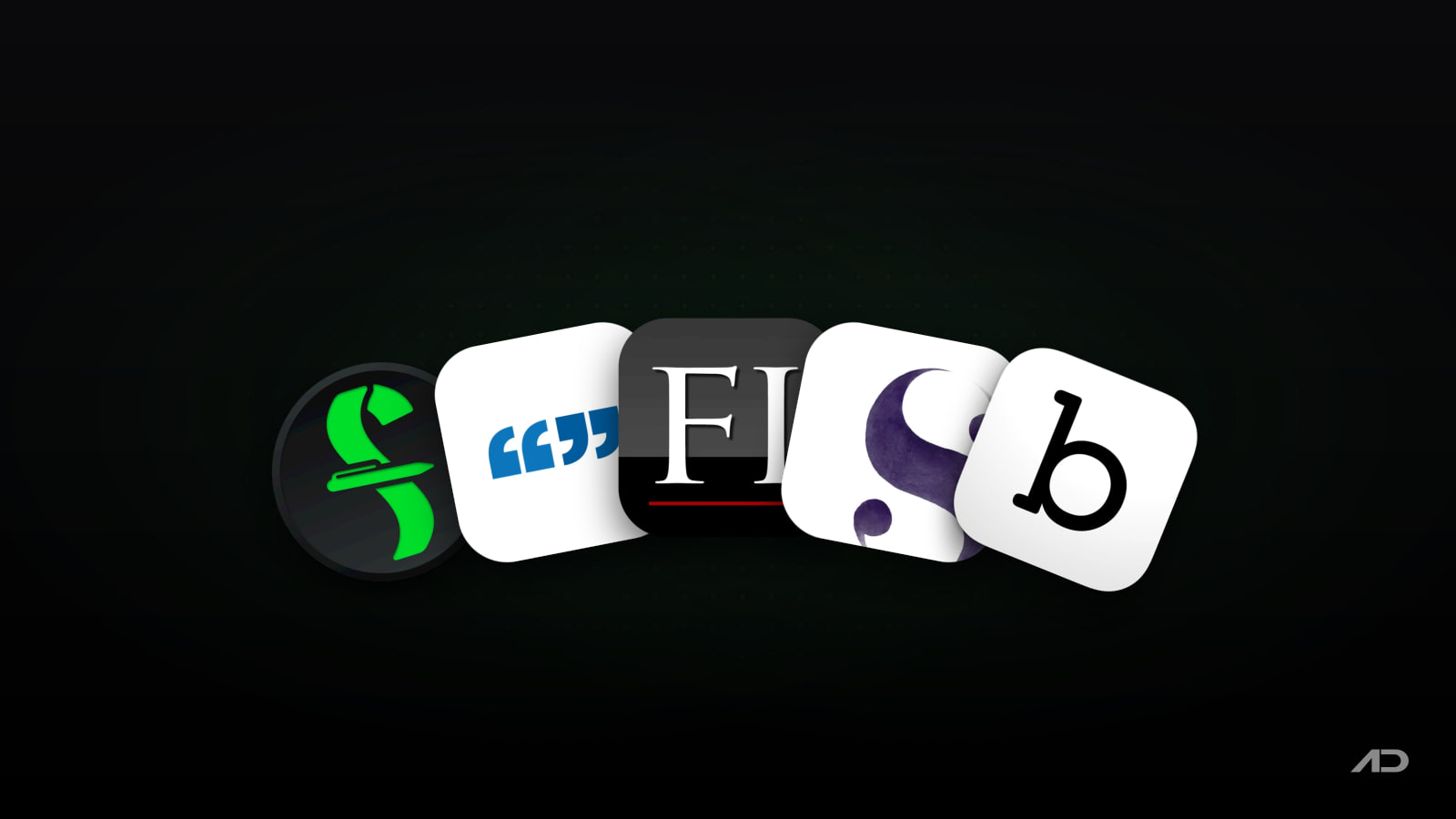
Final Draft Alternatives for Mac: Highland, Fade In, Scrivener, and Beat Compared
Final Draft is still the name most screenwriters, producers, film schools, and production offices recognize first. It is built around industry-standard screenplay formatting, templates, revision tools, collaboration, production reports, and handoff to people who expect Final Draft files.
But Final Draft is not the only serious screenplay app on Mac. Highland is cleaner and more writer-friendly if you like plain-text-style drafting with beautiful PDF output. Fade In is the most direct professional alternative for writers who want deep screenplay features without Final Draft pricing. Scrivener is stronger when a screenplay is part of a larger research-heavy writing project. Beat is the free Mac-native option for Fountain-based screenwriting.
This guide compares Final Draft alternatives for Mac across screenplay formatting, outlining, revision workflows, production features, collaboration, file compatibility, writing feel, learning curve, privacy posture, and current pricing.
Quick Verdict
Choose Final Draft if you need the safest professional handoff, Final Draft file compatibility, collaboration, revision colors, production tools, templates, title pages, reports, and a format most industry collaborators already understand.
Choose Highland if you want a cleaner Mac writing environment for screenplays, stage plays, novels, and manuscripts, with Fountain-friendly text, strong formatting output, and fewer production-office features to manage.
Choose Fade In if you want the closest Final Draft replacement at a lower one-time price, with screenplay formatting, revisions, reports, production tools, collaboration, and strong import/export support.
Choose Scrivener if your script depends on research, character notes, scene fragments, outlines, corkboards, and manuscript organization before it becomes a final screenplay.
Choose Beat if you want a free, native Mac screenwriting app built around Fountain, especially for drafts, indie projects, students, and writers who prefer plain text.
Feature Comparison
| Feature | Final Draft | Highland | Fade In | Scrivener | Beat |
|---|---|---|---|---|---|
| Best for | Professional screenplay handoff, studio-style revisions, production reports, and industry-standard files | Focused Mac writing, Fountain-style drafting, clean script output, and writers who want less interface weight | Professional screenwriting without Final Draft pricing, including revisions, reports, and production-oriented workflows | Long projects with research, notes, chapters, scenes, outlines, and script drafts in one project binder | Free Mac-native Fountain screenwriting, indie drafts, students, and plain-text-friendly workflows |
| Mac app style | Mature commercial desktop app for Mac and Windows, with iPad and iPhone companion apps available separately | Mac and iOS writing app with a cleaner Apple-first interface | Cross-platform professional app for Mac, Windows, Linux, iPhone, iPad, and Android | Mature Mac writing studio, also available for Windows and iOS through separate licenses | Native Mac app focused on screenwriting and Fountain files |
| Screenplay formatting | Strongest dedicated screenplay feature set, with SmartType, templates, title pages, revision mode, reports, and production tools | Formats as you write, with Fountain-friendly source text and polished PDF output | Strong automatic formatting, styles, autocomplete, revisions, reports, title pages, and production tools | Scriptwriting mode and templates are useful, but screenplay formatting is part of a broader writing system | Fountain-based formatting with preview/export workflows, better for writing than production administration |
| Outlining and story planning | Beat Board, Outline Editor, Navigator, scene tools, and production-oriented structure views | Navigator, sections, synopses, and a writing-first structure model | Navigator, index cards, scene management, reports, and revision tools | Excellent binder, corkboard, outliner, metadata, snapshots, split editor, and research areas | Outline/sidebar and Fountain markup make structure visible without a heavy database |
| Revisions and production | Best fit here for colored revisions, locked pages, production reports, and handoff expectations | Better for drafting and clean output than production-office revision workflows | Strong revision tracking, production reports, locked pages, and screenplay administration | Snapshots and compile help with revisions, but production workflows require more setup | Good for drafting and export, weaker for formal production revision workflows |
| Collaboration | Real-time collaboration and review-oriented workflows are central selling points | Mostly individual writing and file-based sharing | Includes real-time collaboration features, though collaborators need the app/workflow | Mostly solo writing, with file sync and project sharing requiring care | Mostly local and file-based; best for solo writing |
| File compatibility | Native Final Draft files, PDF, templates, and broad screenplay workflow expectations | Fountain-friendly text, PDF output, and import/export routes for common script workflows | Imports and exports Final Draft, Fountain, PDF, and other screenplay-friendly formats | Compile/export can produce Final Draft and other formats, but it is not a Final Draft clone | Fountain-first files, with export routes that suit open text workflows |
| Current pricing snapshot | Final Draft 13 is currently listed at $199.99 for a full standalone license and $99.99 for upgrades; Final Draft Suite is listed separately at $9.99/month or $99.99/year | Free download with Highland Pro currently shown through the App Store as $9.99/month or $59.99/year | Fade In Professional is currently listed at $79.95 for a full license, with a free downloadable demo | Scrivener for macOS is currently listed at $59.99, with a full-featured trial that counts 30 days of actual use | Free |
Final Draft
Final Draft is the default choice when compatibility matters more than simplicity. If a producer, coverage service, contest, studio, film-school class, or collaborator asks for a Final Draft file, using Final Draft removes a layer of translation risk.
The current product pages position Final Draft 13 around screenplay formatting, SmartType, templates, the Beat Board, Outline Editor, Navigator, title pages, script notes, real-time collaboration, revision tracking, production reports, and file handoff. That makes it the strongest app here for writers who are already close to production or who regularly exchange files with people in a Final Draft-centered workflow.
Final Draft also has the most category gravity. Many alternatives can import or export Final Draft files, but that is still not the same as living inside the original app. If your work depends on exact page breaks, revision colors, locked pages, title pages, reports, and collaborators who expect Final Draft behavior, the cost can be easier to justify.
The tradeoff is price and weight. Final Draft is expensive compared with the alternatives here, and many writers do not need its production-side depth while drafting alone. The current store lists Final Draft 13 at $199.99 for a new standalone license and $99.99 for upgrades, while Final Draft Suite is shown as a separate subscription at $9.99/month or $99.99/year.
Choose Final Draft if professional compatibility, production handoff, collaboration, and industry familiarity are worth paying for.
Highland
Highland is the most pleasant Final Draft alternative for Mac writers who want the app to disappear. It comes from Quote-Unquote Apps, the company associated with screenwriter John August, and it is built around the idea that screenplay formatting should not interrupt the sentence you are writing.
Highland's appeal is the source-and-preview model. You write in a clean editor using screenplay-friendly text conventions, then let the app produce correctly formatted pages. That is especially nice for writers who like Fountain or Markdown-style thinking, because the draft remains readable without turning every formatting decision into a toolbar action.
It is not only for feature scripts. Highland is also useful for stage plays, manuscripts, novels, treatments, and other long-form writing where a quiet Mac-native interface matters. The current product and App Store surfaces emphasize writing, formatting, PDF output, navigation, themes, revision-oriented tools, and exports.
The tradeoff is that Highland is more writer's room than production office. It is excellent for drafting and clean output, but it is not trying to beat Final Draft at every production-report, locked-page, and industry-administration feature. If you already know your script will move into a production pipeline, test the handoff before relying on Highland alone.
Highland is currently a free download, with Highland Pro shown through the App Store as $9.99/month or $59.99/year. Regional pricing, trial behavior, and App Store taxes can vary.
Choose Highland if you want a calm Mac screenwriting app that feels better for drafting than managing production paperwork.
Fade In
Fade In is the most obvious Final Draft alternative for writers who want professional screenwriting software at a lower one-time price. It is not a minimalist app. It is a dedicated screenwriting tool with serious formatting, revision, production, and compatibility features.
The current Fade In site highlights automatic screenplay formatting, autocomplete, scene navigation, notes, revisions, reports, production tools, collaboration, and import/export support for common screenplay formats including Final Draft and Fountain. It also runs across Mac, Windows, Linux, iPhone, iPad, and Android, which matters if your writing setup is not Apple-only.
Fade In is strongest when you want Final Draft-like depth without buying Final Draft. It can handle feature scripts, television, stage plays, revisions, locked pages, production reports, title pages, and collaborator workflows. The interface is plainer than Highland and less famous than Final Draft, but the feature set is practical.
The tradeoff is ecosystem recognition. Fade In can exchange files, but some collaborators may still ask for Final Draft specifically. If a production company has strict file expectations, run a compatibility test early. For solo writers, indie filmmakers, students, and professionals who control their own tool choice, Fade In is often the better value.
Fade In Professional is currently listed at $79.95 for the full license, with a free demo available. The current site also says updates are free, but you should verify license terms before buying because software policies can change.
Choose Fade In if you want a professional screenplay app with strong Final Draft compatibility and saner pricing.
Scrivener
Scrivener is not a pure Final Draft clone, and that is the point. It is a writing studio for large, messy projects: novels, nonfiction books, academic work, research-heavy drafts, and scripts that need notes, structure, sources, and fragments living beside the draft.
For screenwriters, Scrivener's value is pre-production thinking. The binder lets you break a project into scenes, folders, notes, characters, research, and drafts. The corkboard and outliner help you reshape structure. Split views keep research beside writing. Snapshots preserve older versions before major revisions. Compile can export to screenplay-friendly formats, including Final Draft workflows.
That makes Scrivener excellent when the script is still being discovered. If you are adapting a book, building a show bible, researching a historical script, developing multiple episodes, or keeping worldbuilding and character notes close to the draft, Scrivener can be more useful than a dedicated screenplay formatter.
The tradeoff is final-script polish. Scrivener can format scripts, but it is broader and more configurable than Final Draft, Highland, Fade In, or Beat. You may spend more time learning templates and compile settings. If your only job is to write a clean spec script and send a Final Draft file, a dedicated screenplay app may be faster.
Scrivener for macOS is currently listed at $59.99. Literature & Latte also offers a full-featured trial for Mac and Windows that counts 30 days of actual use, which is generous if you test writing apps slowly.
Choose Scrivener if your screenplay workflow starts with research, outlines, scenes, notes, and structure rather than a blank industry-formatted page.
Beat
Beat is the best free option in this comparison for Mac users who like Fountain. It is a native Mac screenwriting app designed around plain-text-friendly script files, so your draft remains portable and readable outside a proprietary writing database.
Beat is especially appealing for students, indie filmmakers, hobby writers, and screenwriters who want fewer barriers between idea and draft. Fountain markup keeps character names, dialogue, scene headings, transitions, and notes understandable in text form, while the app handles screenplay preview and export behavior.
The advantage is freedom. Beat is free, Mac-focused, and much lighter than the heavyweight commercial apps. It is a good way to learn screenplay structure without paying first, and it is useful even for experienced writers who prefer open text workflows.
The tradeoff is production depth. Beat is better understood as a writing and drafting app than as a full production-office system. If you need locked pages, revision colors, production reports, studio collaboration, or guaranteed Final Draft-native behavior, Final Draft or Fade In is a safer choice.
Choose Beat if you want a free Mac-native screenplay app and are comfortable with Fountain-style drafting.
Which Final Draft Alternative Should You Use?
Use Fade In if you want the closest professional replacement for Final Draft. It has the strongest mix of price, screenplay-specific depth, production features, and cross-platform support.
Use Highland if you care most about the writing experience. It is the best fit for Mac-first writers who want a clean editor, readable source text, and polished output without a heavy production interface.
Use Scrivener if the script is part of a bigger writing system. It is the right choice for research-heavy scripts, adaptations, long development periods, and writers who need a corkboard, binder, and notes as much as screenplay pages.
Use Beat if free and open text matter most. It is the easiest recommendation for students, indie writers, and anyone who wants to draft in Fountain on Mac.
Stick with Final Draft if collaborators expect it, if production features matter, or if compatibility risk would cost more than the software.
These apps can also complement one another. A writer might outline and collect research in Scrivener, draft quickly in Highland or Beat, move a production-heavy project into Fade In, and keep Final Draft available when collaborators require native .fdx files.
Final Verdict
Final Draft is still the safest professional default. It wins when industry expectations, production workflows, revisions, reports, collaboration, and native Final Draft compatibility matter.
Fade In is the best all-around Final Draft alternative for Mac. It gives serious screenwriters many of the same practical tools at a much lower one-time price.
Highland is the best writing-first alternative. It is calmer, more Mac-native, and better for writers who want formatting to stay out of the way.
Scrivener is the best development-room alternative. It is not the cleanest screenplay formatter, but it is excellent for research, outlining, adaptation, and complex long-form writing.
Beat is the best free Mac alternative. It is simple, open, and useful for Fountain-based drafting, especially before a project needs production administration.
My practical recommendation: choose Final Draft when professional handoff is non-negotiable, buy Fade In if you want a serious lower-cost alternative, try Highland if the writing feel matters most, use Scrivener when research and structure are the hard part, and start with Beat if you want a free Mac-native screenplay workflow.
Note: Features and prices are current as of August 2026. Subscription terms, App Store pricing, regional taxes, upgrade pricing, free/demo limits, collaboration behavior, import/export fidelity, screenplay formatting rules, and Mac system requirements can change. Verify current details on each developer's official product, pricing, support, App Store, or documentation page before buying or moving an active script.
Presentify: Draw, highlight, and zoom on your Mac screen.
Annotate your screen, highlight your cursor, spotlight key areas, and zoom in during presentations, demos, tutorials, and screen shares.